What ‘Indo-Western’ Really Means in 2026
For a long time, “Indo-Western” was easy to define. It meant blending two worlds, taking something traditional and pairing it with something modern. A familiar formula: Indian craftsmanship softened with Western silhouettes, or Western outfits layered with ethnic elements.
5/7/20263 min read
It worked. But over time, it also became predictable.
In 2026, that definition no longer holds up the same way. Indo-Western fashion has moved beyond simple fusion. It has become more fluid, more intentional, and far less concerned with fitting into a fixed category.
Beyond the Idea of “Fusion”
Earlier, Indo-Western fashion was often treated as a balance half Indian, half Western.
Today, that balance feels unnecessary.
Designers and wearers alike are no longer trying to split an outfit into two equal influences. Instead, the approach has shifted toward creating something cohesive from the start. An outfit might lean more toward one side, but still carry subtle references to the other.
The result doesn’t feel like a mix. It feels complete on its own.
Craft Is No Longer in the Background
One of the most noticeable changes is the way traditional craftsmanship is being used.
Earlier, craft was often toned down to fit a more contemporary aesthetic. Now, it is being brought forward but in a refined, controlled way.
Handwork, textures, and intricate detailing are being integrated into modern silhouettes without losing their identity. Instead of adapting traditional elements to fit Western styles, designers are building garments where craft becomes part of the structure itself.
This shift has made Indo-Western fashion feel less like a compromise and more like a progression.
Silhouettes Are Redefining the Category
If there is one area where the transformation is most visible, it is in silhouettes.
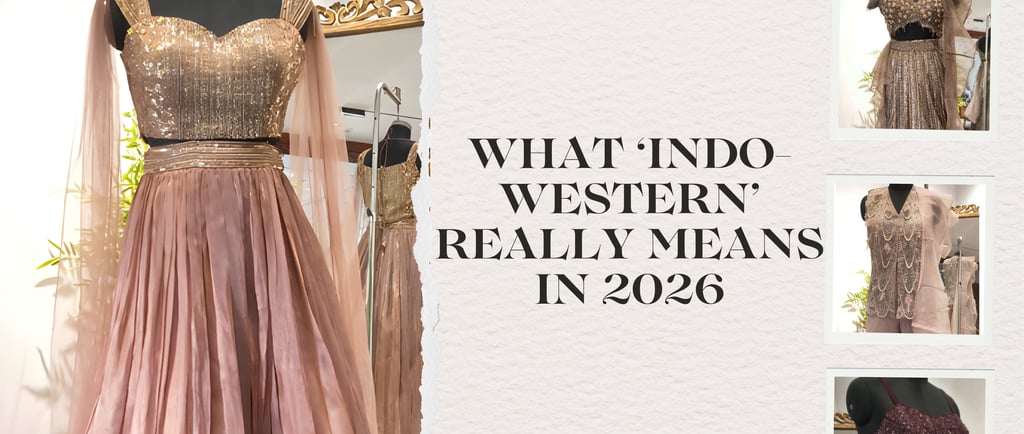
The cuts are sharper, more experimental, and less restricted by traditional formats. Garments no longer follow expected shapes.A piece may carry traditional detailing but exist in a completely modern form. At the same time, something that appears Western at first glance may reveal deeper cultural influences through construction and finish.
This interplay between form and detail is what gives Indo-Western fashion its current edge.
From Occasion Wear to Everyday Relevance
Indo-Western fashion was once largely associated with occasions, festivals, weddings, or formal gatherings.
That distinction has gradually faded.
Today, similar pieces are being styled for everyday wear. The same outfit can be adapted across settings with minimal changes, making it more versatile and accessible.
This shift has expanded the role of Indo-Western fashion. It is no longer reserved for specific events it has become part of regular wardrobes.
A More Personal Approach to Style
Another important change lies in how people approach dressing itself.
There is less emphasis on labels and categories. Instead of asking whether an outfit is “Indian” or “Western,” the focus has moved toward whether it feels authentic to the person wearing it.
This has opened up more freedom in styling. People are mixing influences without needing to justify them, leading to combinations that feel more natural and less constructed.
Indo-Western, in this sense, has become less of a category and more of an expression.
The Evolving Role of Color
Color has also taken on a more intentional role.
Where earlier fusion wear often relied on safe, muted palettes, today’s approach is more deliberate. Color is used to create contrast, highlight structure, and define the overall tone of the outfit.
Whether bold or minimal, it is rarely accidental.
This shift in color usage adds another layer of depth, making the outfit feel more considered and less formulaic.
Confidence Over Convention
Perhaps the most defining change is the shift in mindset.
Indo-Western fashion is no longer trying to appeal to everyone. It is not about softening tradition or making Western styles more culturally acceptable. Instead, it embraces a more confident approach.
Some designs lean strongly in one direction. Others experiment freely. Not every combination is meant to be universally liked and that is part of its strength.
The focus has moved from approval to individuality.
What Indo-Western Means Today
In 2026, Indo-Western fashion cannot be reduced to a simple definition.
It represents:
the integration of traditional craftsmanship into modern design
the freedom to experiment with silhouettes and structure
the blending of influences without rigid boundaries
and a shift toward personal expression over fixed categories
Conclusion
Indo-Western fashion has evolved from a concept of fusion into something far more dynamic.
It is no longer about combining two distinct styles in equal parts. Instead, it is about creating garments that naturally carry multiple influences without needing to separate them.
In 2026, Indo-Western is less about what you wear and more about how you choose to define your style.
It doesn’t follow rules.
And that is exactly what makes it relevant.